“How many employees do you have?”
That used to signal power. Scale. Success.
But that metric is dying.
Today, the real metric is revenue per employee.
Look at the numbers:
hashtag#Apple generates over $2.5M per employee.
hashtag#NVIDIA generates over $3M per employee.
hashtag#Instagram had 13 employees when it sold for $1B.
hashtag#WhatsApp had 55 employees when it sold for $19B.
That’s not luck.
That’s not hype.
That’s system design.
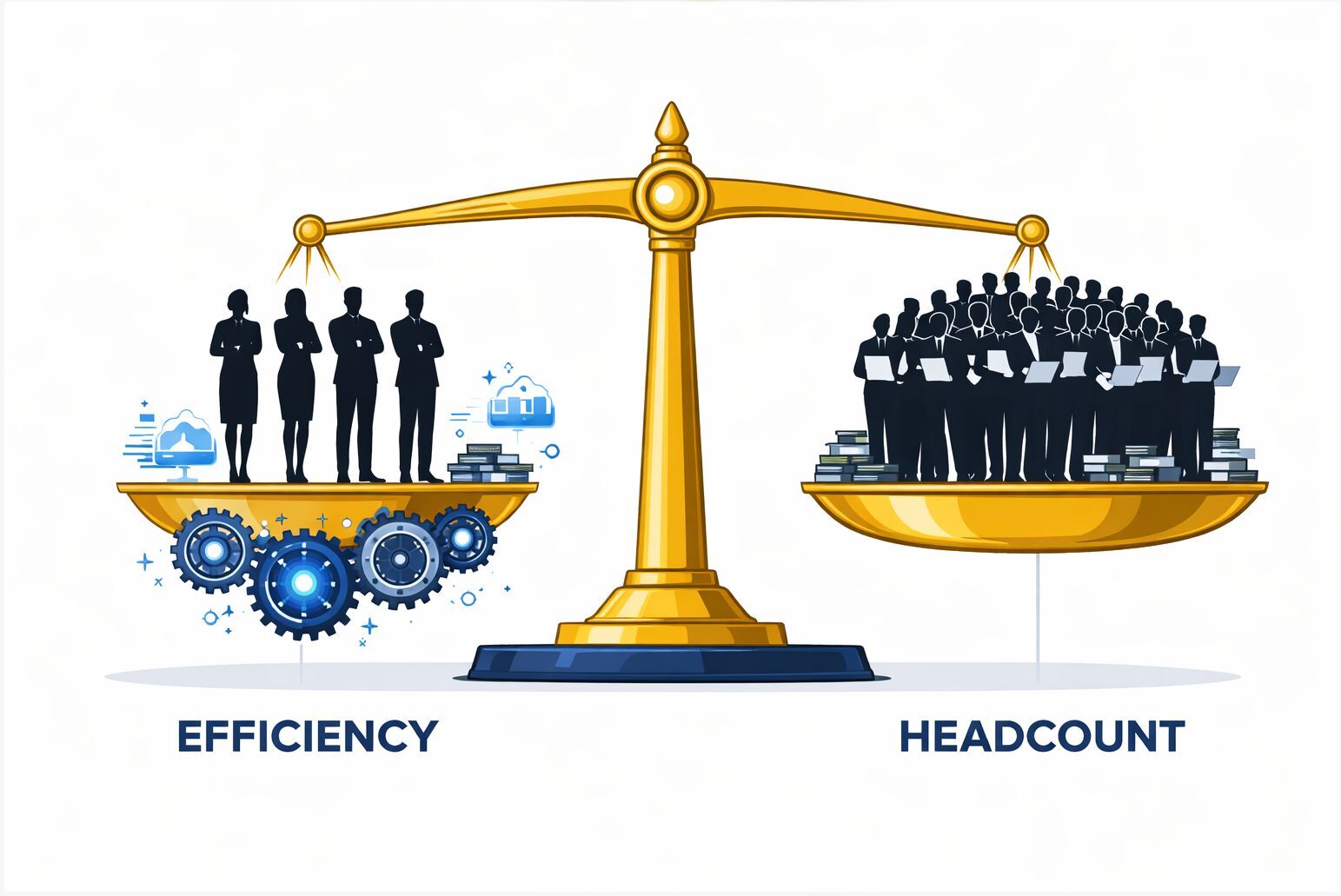
We’ve entered an era where leverage beats labor.
AI compresses knowledge gaps.
Automation removes repetitive execution.
Well-structured systems eliminate dependency on memory and chaos.
The companies winning right now aren’t hiring faster.
They’re designing smarter.
The real question is no longer:
“How many people do we need?”
It’s:
“How do we increase output per person?”
Because a 10-person company with clean systems will outperform a 100-person company drowning in hashtag#Slack threads, manual tasks, and approval bottlenecks.
And here’s the uncomfortable truth:
Most companies don’t have a talent problem.
They have a systems problem.
If your growth requires hiring before optimizing,
you’re scaling inefficiency.
If your team needs memory instead of workflows,
you’re operating on fragility.
Headcount used to signal size.
Now efficiency signals intelligence.
And the companies that understand how to design operational leverage
will quietly dominate the next decade.
The question isn’t whether hashtag#AI will change hashtag#business.
The question is whether your systems are built to take advantage of it.